

+12.2points
Higher rate of stable placement under target-first than reference-first, any time in the episode.
Nano +14.6Edge +8.1FLUX +13.8
95% interval 8.6–15.4 · adjusted p < 0.001
How the effect variesSpatial Instruction Sensitivity in World-Action Models
1General Motors Robotics · 2RIVeR Lab, Northeastern University
Same model, same start, same goal. Only the wording changes. Naming the reference before the object to move lowers stable placement by 12.2 points across three world-action models and 864 rollouts.
“Move the mustard bottle on the table so that the mustard bottle is to the right of the raisin box.”
Kept Lifts the mustard at 9 s and sets it down to the right of the raisin box at 23 s.
“Move the mustard bottle on the table so that the raisin box is to the left of the mustard bottle.”
Never placed Pushes the mustard without lifting it. From 25 s the gripper is on the raisin box instead.
Cosmos3 Edge, start state 2 of 8, played at 2×. Unedited simulator recordings from an exterior camera, cropped and rotated upright as in the paper. The camera faces the robot, so image left is the robot’s right. The lanes are scored from simulator state after the fact.
World-action models (WAMs) generate robot actions together with predictions of future observations. Their usefulness as general-purpose policies depends on turning a user’s description into the intended manipulation. For a spatial placement, that means identifying both the object to move and its destination, which is fixed relative to a reference object.
“Move the mustard bottle on the table so that the mustard bottle is to the right of the raisin box.”
Three wordings per goal03 →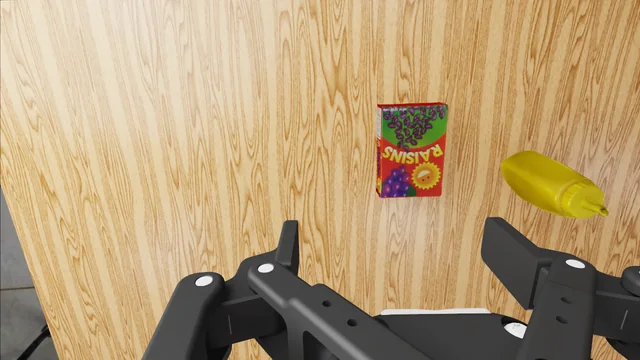
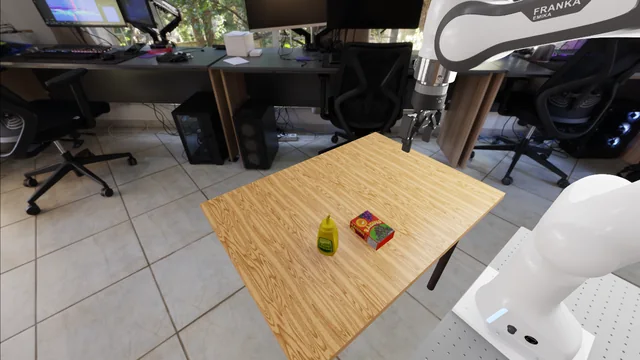
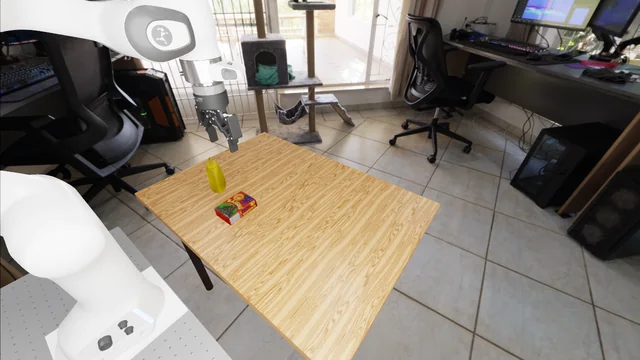
The robot executes the actions, the cameras and state update, and the model is asked again, with the same instruction, until the episode ends.
A placement goal names two objects: the target to move and the reference that fixes where it goes. The same arrangement can be stated from either side, because the mustard is to the right of the raisin box exactly when the box is to the left of the mustard. We therefore write every goal three ways and run each from the same start.

Command mustard bottle to the right of raisin box
Same goal, same start, and the robot is asked to move the mustard every time.
Does the policy respond consistently to equivalent language instructions?
Prior work asks neighbouring questions. We focus on a specific consistency requirement: preserving the intended manipulation when the same spatial goal is described from another object’s perspective.
Whether policies respond to language when scenes are visually similar.
Whether policies follow a goal that differs from the one the scene suggests.
Whether policies withstand reworded instructions and distracting additions.
Counterfactual supervision and semantic guidance to make policies follow instructions.
Target-first and reference-first describe one arrangement from opposite objects. A consistent policy should move the same object to the same place under both.
We compare three released WAMs under alternative instructions from identical initial scenes. Success under one description does not imply consistency across equivalent descriptions, and opposite effects across spatial relations can cancel in an overall score. The rollouts also show a limit of spatial scoring: the requested relation can become true because the wrong object moved, or disappear under continued control. To separate language understanding from action generation, we also test each model’s vision–language backbone on its own.
3 world-action models times 12 placement goals times 3 wordings per goal times 8 starts per scene equals 864 paired rollouts, 20 to 40 seconds each, every one on video.
Target-first and reference-first start with the same command and ask the robot to move the same object. They differ only after “so that”: reference-first makes the reference the subject and states the relation from its side. Across the three models, that lowers the rate of stable placement by 12.2 percentage points, and the gap appears in every model.
Try , the largest gap, and , where it reverses.
Move the mustard bottle on the table so that the mustard bottleisto the right ofthe raisin box.
The object to move is the subject of the clause.
DIR Direct command, for comparison: “Place the mustard bottle on the table to the right of the raisin box.”
Same model, same start: 18 placed under TF only, 0 under RF only.
TF and RF change both the order of the objects and the relation word, so this comparison cannot say which of the two drives the effect. Per-goal and per-model numbers are descriptive.
Higher rate of stable placement under target-first than reference-first, any time in the episode.
95% interval 8.6–15.4 · adjusted p < 0.001
How the effect variesPaired runs where only TF placed versus only RF. The other 229 of 288 pairs agreed.
Same start, same modelStable placements undone before the episode ended. The overall rate halves from any time to the final second.
Still placed in the final second
Undone before the end
Rates weight the four scenes equally.
RF instructions that FLUX’s text encoder, tested alone, read with the relation reversed. TF: 0 of 10 errors.
A test of the language model, not a causal explanation of rollouts.
Language testsEach model attempts each goal from the same recorded starts, once per wording. The robot and objects are reset before every instruction and the random seed is fixed, so the three wordings begin from the same saved simulator state. Every placement rate on this site comes from these 864 paired episodes.
18 startstarts × 112 goalgoals × 3 wordings × 3 models = 972864 episodes
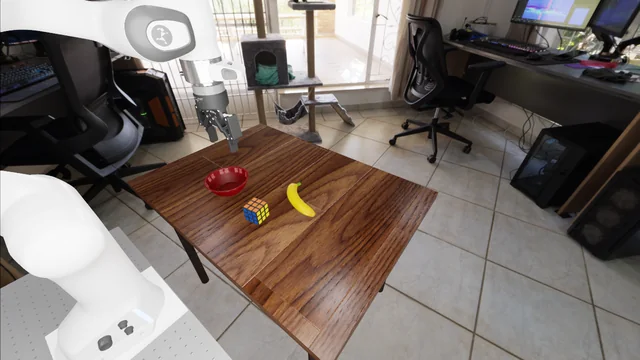
Start 2 of 8 in the mustard scene. Every run from this start begins in the same saved simulator state. The camera faces the robot, so image left is the robot’s right.
One goal, in the robot’s frame: the mustard bottle to the right of the raisin box. The drawing shows the same start from above. The wedge marks the directions that count as “right of”, and the dashed outline is one placement that would count.
Three wordings of that goal. All three ask the robot to move the mustard bottle; only the words differ.
Each wording runs once on each model, with the same seed: 3 × 3 = 9 episodes from this start.
The same nine runs from each of the scene’s 8 starts: 72 episodes. The three dots in a cell share the model, goal and start; only the wording differs.
All 12 goals in the four scenes, each from its scene’s 8 starts: 864 episodes. Point at or tap a dot to see its run, or focus the matrix and use the arrow keys.
Of 864 episodes, 191 were placed and kept, 192 were placed and then lost, and 481 were never placed. Cosmos3 Nano: 142 of 288 placed at some point.Cosmos3 Edge: 93 of 288 placed at some point.FLUX 3 Action: 148 of 288 placed at some point.
The scenes come from RoboLab, a simulation benchmark for generalist manipulation policies. Seven goals are RoboLab’s own; five more reuse the same objects. Each start is a small change in the object poses that a scripted controller can solve. Every goal, wording and model in a scene shares the same eight starts. A scene with two bins had no qualifying start and was dropped before any outcomes were collected.
 Robot Start 1
 Robot Start 1
 Robot Start 1
 Robot Start 1
Top views at the first step, rotated so that the robot sits at the top edge. The robot’s left is therefore the image’s right. “RoboLab” marks the benchmark’s own goals; “Added” goals reuse the same objects. ✓ marks a goal that already holds at the start. The logged object poses at the first step are identical for every goal, wording and model that shares a start; the rendered frames differ only by small rendering noise.
The direct command (DIR) keeps RoboLab’s original wording where it exists, spelling included. Target-first (TF) and reference-first (RF) start the same way and ask the robot to move the same object. After “so that”, TF describes the target relative to the reference. RF describes the reference relative to the target, with the relation inverted.
Each row is one goal; the three columns are its three wordings.
| Goal | DIR Direct | TF Target-first | RF Reference-first |
|---|---|---|---|
| Cube, bowl and banana | |||
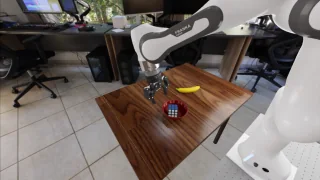
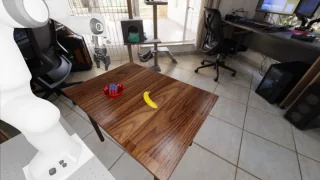
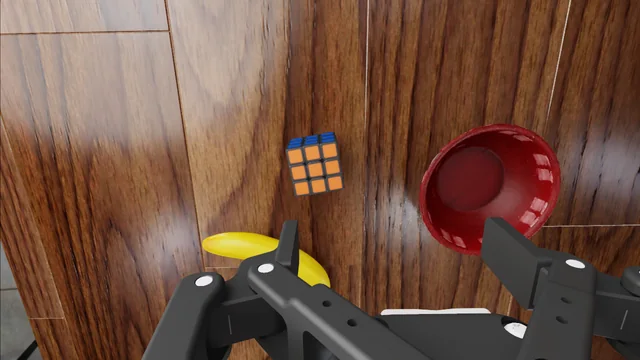
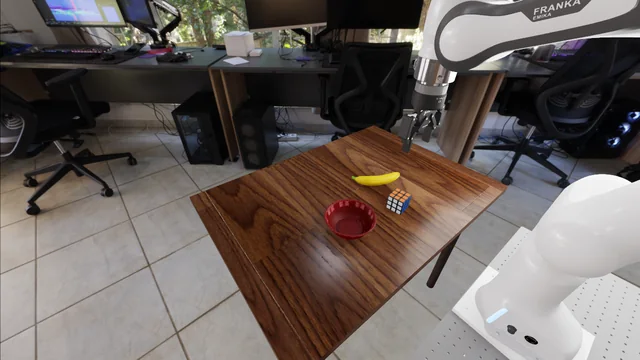
| Cube left of bowl RoboLab | Put the rubiks cube to the left of the bowl | Place the Rubik's cube so that the Rubik's cube is to the left of the bowl. | Place the Rubik's cube so that the bowl is to the right of the Rubik's cube. |
| Cube right of bowl ✓ Added | Put the rubiks cube to the right of the bowl | Place the Rubik's cube so that the Rubik's cube is to the right of the bowl. | Place the Rubik's cube so that the bowl is to the left of the Rubik's cube. |
| Cube in front of bowl RoboLab | Put the rubiks cube in front of the bowl | Place the Rubik's cube so that the Rubik's cube is in front of the bowl. | Place the Rubik's cube so that the bowl is behind the Rubik's cube. |
| Cube behind bowl RoboLab | Put the rubiks cube behind the bowl | Place the Rubik's cube so that the Rubik's cube is behind the bowl. | Place the Rubik's cube so that the bowl is in front of the Rubik's cube. |
| Butter box and raisin box | |||
| Butter box on raisin box RoboLab | Pick up the butter box and place it on top of the raisin box | Place the butter box so that the butter box is on top of and supported by the raisin box. | Place the butter box so that the raisin box is underneath and supporting the butter box. |
| Butter box left of raisin box Added | Place the butter box on the table to the left of the raisin box. | Move the butter box on the table so that the butter box is to the left of the raisin box. | Move the butter box on the table so that the raisin box is to the right of the butter box. |
| Butter box right of raisin box ✓ Added | Place the butter box on the table to the right of the raisin box. | Move the butter box on the table so that the butter box is to the right of the raisin box. | Move the butter box on the table so that the raisin box is to the left of the butter box. |
| Mustard bottle and raisin box | |||
| Mustard bottle on raisin box RoboLab | Place the mustard on the raisin box. | Place the mustard bottle so that the mustard bottle is on top of and supported by the raisin box. | Place the mustard bottle so that the raisin box is underneath and supporting the mustard bottle. |
| Mustard bottle left of raisin box ✓ Added | Place the mustard bottle on the table to the left of the raisin box. | Move the mustard bottle on the table so that the mustard bottle is to the left of the raisin box. | Move the mustard bottle on the table so that the raisin box is to the right of the mustard bottle. |
| Mustard bottle right of raisin box Added | Place the mustard bottle on the table to the right of the raisin box. | Move the mustard bottle on the table so that the mustard bottle is to the right of the raisin box. | Move the mustard bottle on the table so that the raisin box is to the left of the mustard bottle. |
| Two bowls | |||
| Left bowl onto right bowl RoboLab | Stack the left bowl on the right bowl | Move the left bowl so that the left bowl is stacked on the right bowl. | Move the left bowl so that the right bowl is underneath and supporting the left bowl. |
| Right bowl onto left bowl RoboLab | Stack the right bowl on the left bowl | Move the right bowl so that the right bowl is stacked on the left bowl. | Move the right bowl so that the left bowl is underneath and supporting the right bowl. |
We evaluate the DROID versions of Cosmos3 Nano, Cosmos3 Edge and FLUX 3 Action. Each model keeps its released implementation and image preprocessing. The cameras, the action rate and the seed are the same for all three.
Selected for strong RoboLab performance.
Language backbone Qwen3-VL-8B-Instruct
Provides a smaller Cosmos comparison.
Language backbone Cosmos3-Edge reasoner
Selected for strong RoboLab performance.
Language backbone Qwen3-VL-4B-Instruct
| Setting | Cosmos3 Nano | Cosmos3 Edge | FLUX 3 Action |
|---|---|---|---|
| Arithmetic | bfloat16 | bfloat16 | bfloat16 |
| Sampling steps | 4 | 4 | 4 |
| Sampler | UniPC | UniPC | Cosmos UniPC |
| Noise shift | 5.0 | 5.0 | 5.0 |
| Visual guidance | 3.0 | 3.0 | 4.0 |
| Action guidance | — | — | 1.0 |
| Observation history | 1 | 1 | 1 |
| Actions per request | 32 | 32 | 32 |
| Control frequency | 15 Hz | 15 Hz | 15 Hz |
| Prompt JSON formatting | No | Yes | No |
| Input/canvas setting | 540×640 | 540×640 | 544×736 |
A scorer checks the requested arrangement from the simulator’s object poses and contacts. A stable placement needs the relation, support, a target released from the gripper, and a speed below 2 cm/s, all held for one continuous second. Directions use the robot’s frame. Try it:
mustard bottle (target) raisin box (reference) where the relation holds
“Move the mustard bottle on the table so that the mustard bottle is to the right of the raisin box.”
The scorer gives every run two outcomes. Both use the same stable-placement conditions: the requested relation, support, a target released from the gripper and moving slower than 2 cm/s.
The conditions hold for one continuous second at some point during the episode.
The same conditions hold throughout the final second of the episode.
Percentages weight the 4 scenes equally, as in the paper; counts are raw. 192 of the 383 runs credited at some point are no longer in place at the end. Where those placements go →
Every comparison is paired: two wordings, same model, same start, same goal. Choose a comparison and watch how the paper turns 288 pairs into an estimate, an interval and a test.
Bootstrap the starts. Within each scene, draw eight of its starts with replacement, keeping every goal, model and wording of a start together, and recompute the mean. Repeat 10,000 times; the middle 95% of the means is the interval.
Seeded draws illustrate the procedure, so their interval and p-value can differ slightly from the paper’s. The values reported in the paper are shown at the top of this panel. Units are percentage points of the placement rate.
The scorer reads simulator state after each run; the policies never see it. Its two outcomes describe placements, not complete instruction following: neither identifies which object moved. Across all 4 scenes the set-up is identical for the three wordings, so the differences in the next sections come from the words.
The 12.2-point target-first advantage is an average. Each of the 32 physical starts gives its own paired difference: 21 favour TF, 4 favour RF and 7 tie. By goal the effect ranges from −25.0 to +75.0 points, reverses for one goal, and cancels out completely in the cube scene. This section shows every number behind the headline, including the appendix tables.
Each dot is one physical start: the difference in placement rate between two wordings from that start, averaged over its goals (and, in the top row, over the three models). Pairing this way cancels out how hard a start is. Switch the contrast to bring in the direct instruction, or the outcome to require the placement at episode end.
TF minus RF, at any time: +12.2 points across all three models, 95% interval [8.6, 15.4]. Nano +14.6, Edge +8.1, FLUX +13.8.
TF and RF change both object order and relation vocabulary, so this comparison does not identify which aspect drives the effect.
Each dot is one of the 32 physical starts (eight per scene). Its position is the paired TF − RF difference in stable placement for that start, averaged over the scene’s goals and, in the top row, over the three models. Tied dots stack vertically; a full stack continues one dot-width to the side. Diamonds and bars show the mean and its 95% interval from 10,000 bootstrap draws of starts within scenes. Adjusted p-values appear only for the two original pooled any-time tests (TF − RF and DIR − TF, Holm correction); all other rows are descriptive.
Same model, start and goal; at any time. The remaining pairs agree: both wordings placed, or neither did.
Raw counts of paired runs in which exactly one wording reached a stable placement: 96 pairs per model (12 goals × 8 starts). They include the three goals already true at the start, which never disagree at any time. Unlike the dots above, these counts are not averaged within scenes. Computed from the released episode outcomes; the paper does not report them.
Pooled over models, the TF − RF gap ranges from −25.0 points for cube-behind to +75.0 for mustard-right. The heatmap gives each model’s placements out of eight for every goal and wording; the forest gives the pooled difference with its interval. Each goal rests on eight physical starts, so these per-goal estimates are descriptive: they show where the effect is, not a rule for every task.
Mustard bottle right of raisin box. TF minus RF +75.0 points, 95% interval [58.3, 87.5]. TF 20, RF 2, DIR 19 of 24 at any time.
95% CI [58.3, 87.5] · descriptive, from eight physical starts
| Any time / end | DIR | TF | RF |
|---|---|---|---|
| Nano | 7/3 | 8/6 | 0/0 |
| Edge | 4/3 | 4/4 | 0/0 |
| FLUX | 8/8 | 8/3 | 2/0 |
| All models | 19/14 | 20/13 | 2/0 |
Left: runs out of 8 that reached a stable placement, for each model and wording. Right: the paired TF − RF difference for each goal at any time, pooled over the three models, with a 95% interval from that scene’s eight physical starts. Counts on the right are any-time placements out of 24 runs. Per-goal estimates rest on only eight starts each and are descriptive. Goals marked † are already true in all eight starting states: they pass at any time under every wording and contribute zero to the difference.
In the cube scene, effects in opposite directions cancel: RF does better for cube-behind even though the scene’s average gap is zero. An aggregate score can therefore hide sensitivity to individual relations.
In the cube scene, cube-left (+16.7) and cube-front (+8.3) favour TF, while cube-behind (−25.0) favours RF. The opposite effects cancel exactly: the scene average is ±0.0 points, although its goals respond to the wording in opposite directions. Across the scene’s 96 runs per wording, TF placed 35 times and RF 35 times.
Each bar adds one goal’s paired TF − RF difference at any time, pooled over the three models; the counts beside each goal are its TF and RF placements out of 24. Bars to the right favour TF, bars to the left favour RF. Goals marked † are already true at every start and add zero. The pooled estimate averages the goals within each scene and then weights the four scenes equally, so a scene whose goals cancel contributes nothing to it.
The rates behind the paired differences, balanced across scenes as in the paper. RF is the lowest of the three wordings for every model, under both outcomes and with or without the goals already true at reset. Fewer than half of the any-time placements also pass the episode-end check.
| Model | DIR | TF | RF | All |
|---|---|---|---|---|
| Nano | 50.3 | 50.8 | 36.2 | 45.7 |
| Edge | 36.5 | 31.0 | 22.9 | 30.1 |
| FLUX | 63.3 | 56.0 | 42.2 | 53.8 |
| All models | 50.0 | 45.9 | 33.8 | 43.2 |
Rates average the goals within each scene and weight the four scenes equally, as in the paper; per-model rates are descriptive. Any-time and end scores assess placement only; neither shows that the requested object was the one moved.
Across the 864 episodes, 383 reach a stable placement and 191 also pass the episode-end check, so 192 of the 383 any-time passes (50.1%) fail at the end. Among the 648 episodes whose goals are not true at reset, 167 reach a placement and 94 pass the final check; the other 73 are 43.7% of that group’s any-time passes. For goals already true at reset, 97 of 216 episodes pass the final check.
Raw counts pooled over models and wordings, so they need not equal the scene-balanced rates above. An episode can lose and regain a placement, so passing at the end does not show that the placement was held continuously after it was first reached.
The bowl scene needs separate reading: its RF prompt describes the lower bowl as underneath and supporting the target, which does not explicitly require the nesting the benchmark checks. Without that scene the estimate is 10.65 points, so the direction does not depend on the bowl-language ambiguity; that check is descriptive and does not establish that the bowl prompts are equivalent. In an exploratory comparison, the short direct instruction also outperforms reference-first wording on average, by 16.2 points. That comparison was added after the original analyses, and because the forms also differ in length and sentence construction it cannot isolate the effect of changing spatial perspective.
Diamonds are pooled TF − RF estimates in percentage points; bars are 95% intervals from resampling the physical starts within each scene. Only the any-time estimate belongs to the original test family. The end-of-episode and bowl-free summaries are descriptive, and their intervals come from the released study data rather than the paper’s text.
| Model | At any time | At episode end |
|---|---|---|
| All models | 16.2 [11.7, 20.4] | 14.4 [10.0, 18.9] |
| Nano | 14.1 [7.0, 20.8] | 16.1 [4.2, 27.6] |
| Edge | 13.5 [7.8, 19.5] | 8.6 [0.0, 17.7] |
| FLUX | 21.1 [10.4, 30.7] | 18.5 [9.1, 27.6] |
Exploratory DIR − RF gaps in percentage points, with 95% intervals from resampling paired physical starts. Positive values favour the direct instruction. No new multiplicity-adjusted significance claims are made.
The appendix count tables in one place, with totals. Every rate and difference in this section can be rebuilt from them, and they download as CSV.
Each entry gives any-time and episode-end stable-placement counts, both out of eight starts. A dagger marks a goal already satisfied in all eight starting states. Zeros are observed failures. These scores assess the resulting arrangement and do not establish that the requested object moved.
| Goal | Nano | Edge | FLUX | ||||||
|---|---|---|---|---|---|---|---|---|---|
| DIR | TF | RF | DIR | TF | RF | DIR | TF | RF | |
| Cube, bowl and banana | |||||||||
| Cube left of bowl | 8/2 | 6/3 | 0/0 | 3/1 | 2/1 | 0/0 | 1/0 | 0/0 | 4/3 |
| Cube right of bowl† | 8/3 | 8/2 | 8/0 | 8/4 | 8/3 | 8/0 | 8/2 | 8/2 | 8/8 |
| Cube in front of bowl | 1/1 | 1/1 | 0/0 | 0/0 | 1/0 | 0/0 | 0/0 | 0/0 | 0/0 |
| Cube behind bowl | 0/0 | 0/0 | 7/6 | 1/0 | 0/0 | 0/0 | 2/0 | 1/0 | 0/0 |
| Butter box and raisin box | |||||||||
| Butter box on raisin box | 6/5 | 6/5 | 2/1 | 3/2 | 0/0 | 0/0 | 2/2 | 0/0 | 0/0 |
| Butter box left of raisin box | 0/0 | 0/0 | 0/0 | 0/0 | 0/0 | 0/0 | 0/0 | 0/0 | 0/0 |
| Butter box right of raisin box† | 8/5 | 8/4 | 8/6 | 8/5 | 8/3 | 8/7 | 8/4 | 8/6 | 8/3 |
| Mustard bottle and raisin box | |||||||||
| Mustard bottle on raisin box | 5/5 | 6/5 | 4/2 | 0/0 | 0/0 | 0/0 | 7/2 | 5/2 | 6/2 |
| Mustard bottle left of raisin box† | 8/5 | 8/5 | 8/0 | 8/3 | 8/4 | 8/3 | 8/6 | 8/4 | 8/0 |
| Mustard bottle right of raisin box | 7/3 | 8/6 | 0/0 | 4/3 | 4/4 | 0/0 | 8/8 | 8/3 | 2/0 |
| Two bowls | |||||||||
| Left bowl onto right bowl | 0/0 | 0/0 | 0/0 | 0/0 | 0/0 | 0/0 | 7/6 | 8/5 | 1/1 |
| Right bowl onto left bowl | 1/1 | 1/1 | 1/0 | 2/1 | 1/1 | 0/0 | 6/0 | 4/0 | 4/0 |
| All twelve goals, of 96 | 52/30 | 52/32 | 38/15 | 37/19 | 32/16 | 24/10 | 57/30 | 50/22 | 41/17 |
Entries are any-time / end stable-placement counts, each out of eight; † marks a goal already true at reset. Bold entries placed at any time from all eight starts on a goal that was not already true. Goal names open their episodes in the explorer.
The scorer checks spatial outcomes only. A placement counts once the target holds the requested relation for 1 continuous second while it rests on the table, moves slower than 2 cm/s and is clear of the gripper. Neither check identifies which object moved.
Both Nano instructions ask the robot to move the Rubik’s cube behind the bowl. Play them side by side and watch what the gripper holds.
“Place the Rubik's cube so that the Rubik's cube is behind the bowl.”
Rubik’s cube: ended 26.9 cm from its start · bowl: at most 1.3 cm from its start
“Place the Rubik's cube so that the bowl is in front of the Rubik's cube.”
Rubik’s cube: ended 1.9 cm from its start · bowl: at most 28.3 cm from its start
| Check | TFTarget-first | RFReference-first |
|---|---|---|
| Cube behind bowlwithin 45° | … | … |
| Target supported by the table | … | … |
| Target clear of the gripper | … | … |
| Goal metall three | … | … |
| Goal met and still for 1 sunder 2 cm/s | … | … |
| Gripper onnot scored | … | … |
Every row is read from simulator state at the current moment, as the lanes are. Jump to 25.4 s stops both rollouts where the paper’s snapshot was taken.
Both Nano instructions ask the robot to move the cube behind the bowl. In the reference-first rollout, however, the robot holds the bowl while the cube remains on the tabletop. Moving the bowl changes the relative positions enough for the cube-behind check to pass. The target-first rollout does not pass that check. Thus, the reference-first score advantage in this example is not evidence of better instruction following: the predicate credits a relation that became true through manipulation of the wrong object.
Selected from the recorded outcome differences before their videos were inspected. The example illustrates possible behaviour and is not used to estimate how often it happens. Labels describe recorded spatial outcomes, not complete instruction success.
The close views are a fixed crop of one exterior camera. Step through both example pairs at the paper’s snapshot times, or scrub them, in the close view or in a second camera.
Close view. A fixed crop of the exterior camera, rotated 90° for readability, as in the paper’s close views. The camera faces the robot, so image left is the robot’s right. The crop is identical across instruction forms, and no image content is retouched.
Within each pair, both rollouts begin from the same physical state and are shown at the same elapsed time. These are executed observations, not model-generated predictions; the labels under each frame are scored from simulator state at that moment and over the whole episode.
The main score credits a stable placement reached at any time. A stricter check asks whether the placement conditions still hold throughout the final 1 s of the episode. Filter by model or wording to see how many placements survive to the end.
kept 94 lost 73 (43.7% of its placements) never placed 481
kept 97 lost 119 (55.1% of its placements) never placed 0
Across the 864 episodes, 383 reach a stable placement and 191 also satisfy the episode-end criterion. Thus, 192 of the 383 any-time passes (50.1%) fail the episode-end check. Among the 648 episodes whose goals are not satisfied initially, 167 reach a stable placement and 94 pass the final check; the remaining 73 account for 43.7% of that group’s any-time passes. For initially-satisfied goals, 97 of 216 episodes pass the final check.
An episode can lose and regain a placement, so endpoint success does not establish continuous retention after first attainment.
Scene-balanced rates, as in the paper’s figure
These average goals within each scene and weight scenes equally, so they need not equal the raw fractions above (44.3% and 22.1%).
Each episode is assigned the furthest stage it reached: touching the target, lifting it, meeting the goal, and holding a stable placement.
Descriptive no test of significance
Each bar is 96 episodes of one model and wording (288 for all models), split by the furthest stage reached; the number at the right is the share that reached a stable placement at some point. Hatched: episodes whose goal was already true at reset, which start in the goal and only have to keep it.
Reference-first minus target-first, all models, episodes per stage (of 288 each)
Under reference-first wording, more runs stop before lifting the target and fewer reach a stable placement. This describes the recorded distribution only; the paper does not test these stage differences, and the stage breakdown was computed for this website from the same simulator logs.
| Model | Wording | Never touched the target | Touched, never lifted | Lifted, never reached the goal | Reached the goal, never stable | Stable placement | Episodes |
|---|---|---|---|---|---|---|---|
| Nano | Direct | 6 | 9 | 26 | 3 | 52 | 96 |
| Nano | Target-first | 3 | 10 | 25 | 6 | 52 | 96 |
| Nano | Reference-first | 9 | 18 | 27 | 4 | 38 | 96 |
| Edge | Direct | 12 | 10 | 33 | 4 | 37 | 96 |
| Edge | Target-first | 11 | 17 | 35 | 1 | 32 | 96 |
| Edge | Reference-first | 13 | 20 | 39 | 0 | 24 | 96 |
| FLUX | Direct | 0 | 1 | 35 | 3 | 57 | 96 |
| FLUX | Target-first | 0 | 1 | 40 | 5 | 50 | 96 |
| FLUX | Reference-first | 15 | 8 | 27 | 5 | 41 | 96 |
| All models | Direct | 18 | 20 | 94 | 10 | 146 | 288 |
| All models | Target-first | 14 | 28 | 100 | 12 | 134 | 288 |
| All models | Reference-first | 37 | 46 | 93 | 9 | 103 | 288 |
| All models | Reference-first minus target-first | +23 | +18 | −7 | −3 | −31 |
A single rollout that is credited at any time but fails the end check: watch where the goal stops holding.
“Place the mustard bottle on the table to the right of the raisin box.”
| Check | DIRDirect |
|---|---|
| Mustard bottle right of raisin boxwithin 45° | … |
| Target supported by the table | … |
| Target clear of the gripper | … |
| Goal metall three | … |
| Goal met and still for 1 sunder 2 cm/s | … |
| Gripper onnot scored | … |
The episode is credited at any time once the goal has held still for 1 s. Jump to the loss stops where the goal stops holding.
Chosen for this website to illustrate; not one of the paper’s examples, and not a prevalence estimate. Rule: among the 10 Nano and Edge episodes in the mustard scene that reach a stable placement at some point, fail the end check and whose goal was not already true at reset, take the one whose goal does not hold at the last frame and whose last goal-holding interval is longest. The loss was then confirmed in the video.
To separate understanding from manipulation, we gave each policy's vision-language backbone the same 30 instructions and asked it to name the object to move, the reference and the requested relation. FLUX's text encoder reverses reference-first relations, Edge's reasoner errs even on direct commands, and Nano reads every sentence correctly from text, until camera images are added.
DIR 10/10TF 10/10RF 4/10
Camera views of the current scene, captured at the same moment:
empty line: no image
empty line: no image
empty line: no image
Object vocabulary: mustard_bottle, raisin_box
Relation vocabulary: left_of, right_of, in_front_of, behind, on_top_supported, stacked_on, unknown
Instruction:
Move the mustard bottle on the table so that the raisin box is to the left of the mustard bottle.
Reference-first Move the mustard bottle on the table so that the raisin box is to the left of the mustard bottle.
{"target": "mustard_bottle", "reference": "raisin_box", "relation": "left_of"}
mustard right of raisin box
mustard left of raisin box
Nano: direct 10 of 10, target-first 10 of 10, reference-first 10 of 10.Edge: direct 6 of 10, target-first 8 of 10, reference-first 4 of 10.FLUX: direct 10 of 10, target-first 10 of 10, reference-first 4 of 10.
FLUX's text encoder reads every direct and target-first instruction correctly but only four of ten reference-first ones. All six errors name the right objects and reverse the relation. Edge also reads fewer reference-first than target-first instructions correctly, but it errs on direct and target-first ones too, so its difficulty is not limited to reference-first wording. Nano reads all 30.
Nano reads all 30 instructions correctly from text, with or without camera descriptions. With images and descriptions it makes eight relation reversals, five for butter-right and three for cube-behind: reference-first accuracy falls 10.1 points. Images alone cause four butter-right reversals and one butter-on-top error that swaps in a stacking label. The descriptions' extra effect remains unresolved.
Relative to the bowl, place the Rubik's cube to the left.
Place the Rubik's cube to the left, relative to the bowl.
| Reference | Text only | Images + desc. |
|---|---|---|
| Early | 5/8 | 41.7% |
| Late | 8/8 | 59.4% |
Sixteen controls move only the reference phrase and keep the direction. Nano and FLUX answer all of them correctly. Edge answers 5 of 8 reference-early and 8 of 8 reference-late sentences from text. With images and descriptions its reference-early accuracy is 17.7 points lower (95% CI 10.4–25.0).
Relative to the bowl, place the Rubik's cube in front.Edge: cube left of bowl
Relative to the bowl, place the Rubik's cube behind.Edge: cube left of bowl
Relative to the raisin box, place the mustard bottle to the right.Edge: mustard left of raisin box
These controls use different sentences from target-first and reference-first, so they do not settle general noun-order effects.
Accuracy for each backbone, wording and prompt condition. Select a cell to replay its first wrong answer in the console; perfect cells replay a correct one.
| Model | DIR | TF | RF |
|---|---|---|---|
| Nano | |||
| Edge | |||
| FLUX |
| Model | DIR | TF | RF |
|---|---|---|---|
| Nano | |||
| Edge | |||
| FLUX |
| Model | DIR | TF | RF |
|---|---|---|---|
| Nano | |||
| Edge | |||
| FLUX†(auxiliary) |
| Model | DIR | TF | RF |
|---|---|---|---|
| Nano | |||
| Edge | |||
| FLUX†(auxiliary) |
Bars under each score split that cell's answers by class: 10 instructions without images, 80 image prompts with them. Select a cell to load its first error in the console. †FLUX's policy uses this encoder for text only and processes images separately, so its image results are auxiliary.
We also asked whether the current camera views already show the requested relation, allowing an insufficient-evidence answer. Labels come from saved simulator geometry and contact, and each item is asked under both assignments of the yes and no answer codes.
Answerable items, both code orders. Outlined bars give how often the views truly show the relation.
Weights both answers equally, so always answering “no” scores exactly 50%.
Every backbone almost always answers “no”: at most 4.4% “yes”, although 25–28% of the items do show the relation. None of the 4,320 image answers chose insufficient evidence. Balanced accuracy ranges from 48.5% to 50.1%. Only Edge ever answers “yes” when that is true: its recall on matching rollout frames is 5.2% (CI 1.4–9.9).
Each image set is asked whether the views show the relation in the instruction, twice, with the yes and no answer codes swapped. A dot marks a pair answered correctly for both frames.
Place the Rubik's cube so that the bowl is in front of the Rubik's cube.
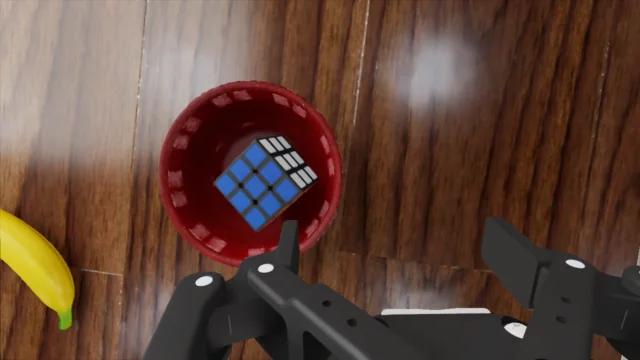
Both frames right under both code orders, RF: Nano 0/11 · Edge 1/11 · FLUX 0/11
World-action models generate robot actions together with predictions of future observations, so each of the three models here also shows what it expects to happen next. Whether those generated videos flag an impending error was the study’s original question. With vision–language models standing in for human annotators, the answer is null.
Before wording became the focus, this was the study’s primary question: does a policy’s generated video help identify an impending manipulation error, such as handling the wrong object or releasing the target into a relation it was not asked for, beyond what is already apparent from the current scene and proposed actions?
The behavioural results arrived first and made wording the paper’s focus. At that point the planned human video annotations were replaced with two vision–language models, before their answers were inspected. The analysis found no measurable benefit from their labels, but the labels are too unreliable to say whether the information is in the videos themselves.
contained a detected error in the actions that accompanied the selected forecast: 14 wrong-object and 33 contradictory release.
Detected from simulator state; not all visually verified.
change in held-out Brier error when the video labels join a classifier of those errors. Negative means they made it slightly worse.
95% interval [−0.00177, +0.00016] includes zero.
of forecasts on which the two annotators agreed on every field. On the final spatial relation alone they agreed in 20.1%.
Agreement, not accuracy: neither annotator was checked against people.
Each time a model is queried it returns a chunk of actions together with a short generated video of the future it predicts. Pick any of the 864 episodes to see the forecast this analysis selected, beside what the cameras then recorded. Wipe and Overlay put the two on top of each other.
The generated prediction is the video the model produced with its chunk of up to 32 actions; the executed view is what the same three cameras recorded while those actions ran, wrist camera above two exterior cameras. Frames are paired by index from the request at frame 0; nominal frame times do not establish the pace of the generated motion. Nano and Edge decode a few rows short of this layout, so their predictions end in a thin black strip. The annotators saw eight generated frames and a numbered episode-start image, never the executed half. Examples follow a fixed rule: the cube-behind episode from start 1 with direct wording for each model, and the first wrong-object and contradictory-release chunks by episode identifier.
For a few episodes the whole sequence of predictions was rendered. Each new request restarts the imagined future from the current scene, so the generated side jumps every time the model replans.
Loading timeline…
Each model’s generated video beside the executed episode, at the same moment. Every new request re-anchors the prediction on the current scene, so the generated half jumps at each boundary on the top strip; within one prediction, frames are paired by index and do not establish the pace of generated motion. A black generated frame would mean no decodable future was available for that moment, which is missing evidence rather than a zero or a failure; none of these 17 episodes has one. The thin black strip under Nano and Edge predictions is padding. Lanes are scored from simulator state. These 17 are the episodes with whole-episode media; none has a detected error in its selected chunk.
One forecast per episode was chosen by a rule fixed without viewing any forecast or outcome. Two vision–language models then labelled it without seeing the instruction, the model or what actually happened.
3 models × 12 goals × 3 wordings × 8 starts. Each request returned a chunk of up to 32 actions at 15 Hz together with a generated video of the future.
Chosen without viewing the forecast or the outcome: the first prediction made while the gripper was within 10 cm of a movable task object. Two Nano episodes never met that condition and use their first prediction. Only frames assigned to actions the policy then performed, before its next prediction, are kept.
Eight forecast frames in a common three-camera layout, and an episode-start image with numbered objects and direction arrows. Ambiguous observations could be labelled unknown.
They replaced the planned human video annotation before anyone inspected their answers.
The comparison object is not necessarily the instruction’s reference.
Qwen chose between the two answers and an unknown option, in random order. Because Qwen also supplied one of the original answers, this step is not independent validation.
A requested or alternative relation counted only when the labels named the intended target as moving and matched that goal’s comparison object and relation.
With no human labels there is no ground truth to score against, only whether the two annotators agree. They agreed on the moving object in 59.1% of forecasts, on the final relation in only 20.1%, and on every field at once in 5.9%.
| Field | Agreement (%) | Cohen’s κ |
|---|---|---|
| Moving object | 59.1 | 0.398 |
| Motion direction | 48.6 | 0.108 |
| Final spatial relation | 20.1 | 0.077 |
| Comparison object | 33.3 | 0.111 |
| Possible release | 93.4 | 0.026 |
| Missing object | 97.7 | 0.000 |
| Hallucinated object | 98.5 | 0.231 |
| All 7 fields at once | 5.9 | not reported |
On the 862 additional episode-start forecasts, every field’s κ stayed below 0.115.
After disagreements were resolved, the labels were classified against each episode’s request: only 4.5% were credited with the requested relation. Separately, 77.9% indicated upward-only motion.
Missing object was labelled no in 864 of 864 forecasts.
Final labels after disagreements were resolved; counts are forecasts. A requested or alternative relation was credited only when the labels identified the intended target as moving and matched that goal’s comparison object and relation, so “Neither” includes forecasts that named a different moving object. Direction categories keep the annotation’s own names. These model-generated labels are unverified: short grasping or lifting clips may reveal little about the eventual placement, but annotation errors are another explanation.
The test asks whether the labels add anything to what the scene and the proposed actions already reveal. For each selected forecast, the scorer checked the chunk of actions that accompanied it for two kinds of error.
At least 0.2 s of continuous gripper contact with a non-target object, which moves at least 2 cm from its position at the start of the chunk.
The target detaches after contact, then rests supported and detached for at least 0.2 s in exactly one registered alternative relation while the requested relation is false, all within the chunk. Alternatives were the other tested cube, butter and mustard relations; bowls had none.
Both checks read simulator state for the chunk of actions that accompanied each selected forecast. They differ from the 1-second stable-placement endpoint used for task success, and they have not all been visually verified: contact followed by detachment can count as a release without substantive prior manipulation.
| Model | Cube | Butter | Mustard | Bowls | Total |
|---|---|---|---|---|---|
| Cosmos3 Nano | 2 wrong-object, 11 release, of 96 | 1 wrong-object, 1 release, of 72 | 0 wrong-object, 0 release, of 72 | 0 wrong-object, 0 release, of 48 | 15 of 288 |
| Cosmos3 Edge | 0 wrong-object, 6 release, of 96 | 0 wrong-object, 1 release, of 72 | 0 wrong-object, 0 release, of 72 | 1 wrong-object, 0 release, of 48 | 8 of 288 |
| FLUX 3 Action | 7 wrong-object, 10 release, of 96 | 2 wrong-object, 2 release, of 72 | 0 wrong-object, 2 release, of 72 | 1 wrong-object, 0 release, of 48 | 24 of 288 |
Two classifiers then predicted which chunks contained an error, one with the information available at the moment of the request and one with the forecast’s labels added.
Both: L2-regularized logistic regression, C = 1, 8 folds each holding out the same initial-state slot across all conditions, preprocessing fitted within the training fold. Wording, future states and final task success were excluded. The comparison uses privileged simulator information and is not a deployable failure detector.
Change in held-out Brier error from adding the video labels, ΔB = Bbaseline − Bwith video
Observed Weights models equally, scenes equally within models and goals equally within scenes.
Per model, descriptive Classifiers refitted on each policy’s episodes; these rows do not decompose the pooled result.
Controls The no-motion control did not pass repeated current images through the video annotators.
Permutation null A permutation distribution, not a confidence interval for the observed effect.
| Model | Events / forecasts | Baseline | With video | ΔB |
|---|---|---|---|---|
| All models | 47 / 864 | 0.04012 | 0.04085 | −0.00073 |
| Cosmos3 Nano | 15 / 288 | 0.04012 | 0.04151 | −0.00139 |
| Cosmos3 Edge | 8 / 288 | 0.02491 | 0.02530 | −0.00040 |
| FLUX 3 Action | 24 / 288 | 0.06210 | 0.06104 | +0.00106 |
Held-out Brier error for predicting detected manipulation errors; lower is better. Model rows are descriptive.
One comparison, made after seeing the results, did show a difference: detected errors were more common when the labels named the reference object as moving (23 of 247, 9.3%) than when they named the requested object (19 of 540, 3.5%).
Exploratory Comparison made after seeing the results
Labels named the reference object as moving
9.3% detected errors in 23 of 247 chunks
10 wrong-object 13 contradictory release
Labels named the requested object as moving
3.5% detected errors in 19 of 540 chunks
2 wrong-object 17 contradictory release
Every result on this page comes from the same 864 rollouts, the same starts and the same scorer. Together they argue for evaluating world-action models on consistency across equivalent instructions, not on task success alone.
@inproceedings{same_goal_different_words_2026,
  title     = {Same Goal, Different Words: Spatial Instruction Sensitivity in World-Action Models},
  author    = {Abbas, Ali-Adeeb and Seraj, Esmaeil and Toghi, Behrad and Padir, Taskin},
  booktitle = {CoRL 2026 Workshop: Do Robots Need World Models?},
  year      = {2026},
  note      = {Under review}
}